CMMS VS ERP
CMMS vs ERP: Choosing the Right System for Pakistani Businesses
Understanding the distinction between a Computerized Maintenance Management System (CMMS) and Enterprise Resource Planning (ERP) is critical.
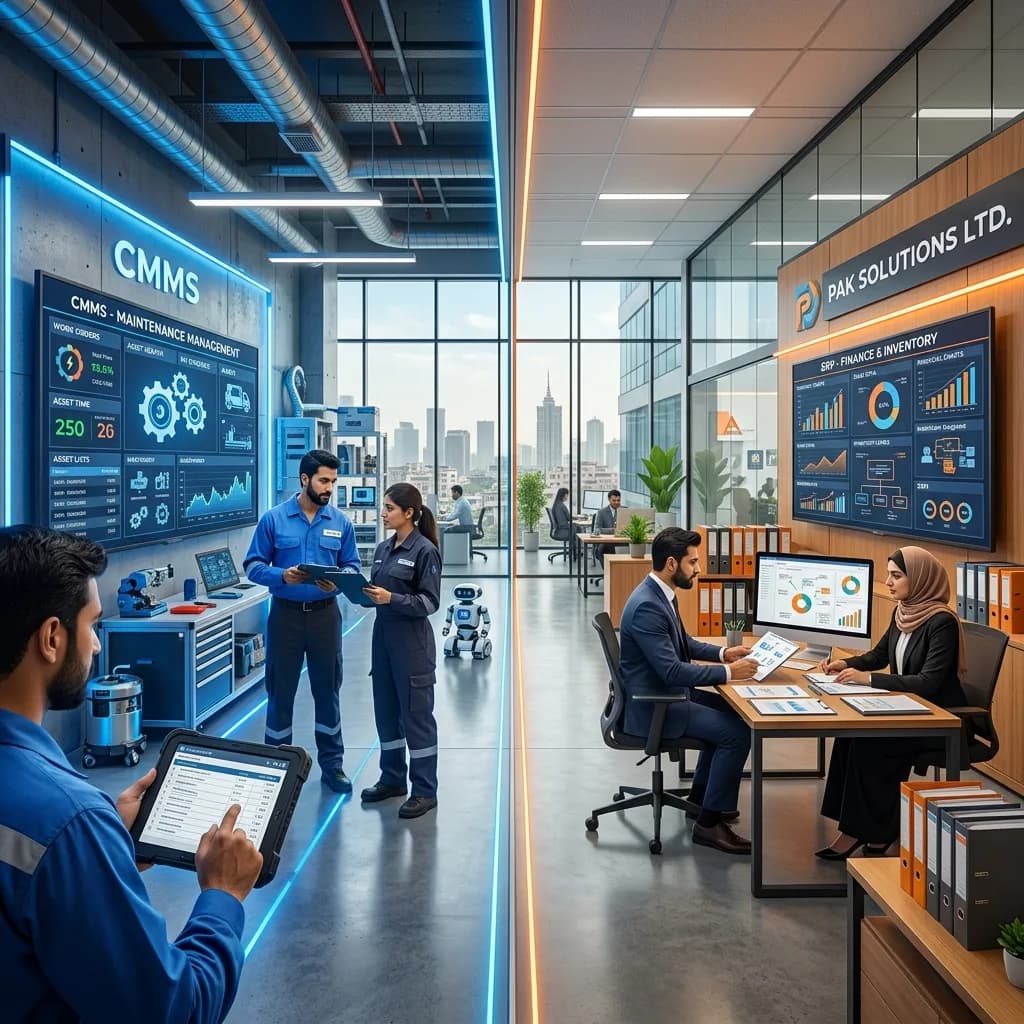
Operating a business in Pakistan brings unique challenges, from supply chain disruptions to fluctuating economic conditions. To navigate these complexities, companies are increasingly turning to digital solutions to streamline operations and protect their bottom line. Two acronyms frequently dominate these conversations: CMMS and ERP.
Understanding the distinction between a Computerized Maintenance Management System (CMMS) and Enterprise Resource Planning (ERP) is critical. While both software solutions improve efficiency, they serve vastly different purposes. This guide will break down the features of both systems, helping Pakistani businesses decide whether they need a CMMS, an ERP, or a powerful combination of both to fuel their growth.
Understanding CMMS (Computerized Maintenance Management System)
A CMMS is a highly specialized software designed to simplify and optimize maintenance operations. It acts as a central hub for all information regarding an organization's physical assets, from manufacturing equipment to fleet vehicles.
Definition and Core Functionalities
At its core, a CMMS keeps your equipment running smoothly. Key functionalities include:
Asset tracking and management: Storing detailed profiles, warranties, and maintenance histories for every piece of equipment.
Work order management: Automating the creation, assignment, and tracking of maintenance tasks.
Preventive maintenance scheduling: Setting up automatic alerts for routine inspections to catch issues before breakdowns occur.
Inventory management for spare parts: Tracking stock levels of crucial replacement parts to avoid repair delays.
Reporting and analytics: Generating insights on asset performance, maintenance costs, and technician productivity.
Benefits for Pakistani Businesses
Implementing a CMMS offers tangible financial and operational benefits. You can significantly reduce equipment downtime, increasing the overall longevity of expensive assets. Maintenance costs are optimized by shifting from reactive, emergency repairs to planned, preventive care. Furthermore, a CMMS improves workplace safety, ensures compliance with local industrial regulations, and helps maintenance managers allocate their team's time far more effectively.
Use Cases in Pakistan
A CMMS shines in asset-heavy industries. Pakistani textile manufacturers, logistics companies managing large delivery fleets, and infrastructure developers rely on CMMS platforms to keep their operations moving without costly interruptions.
Understanding ERP (Enterprise Resource Planning)
An ERP is a comprehensive software suite that manages and integrates a company's core business processes. Instead of focusing on one specific department, an ERP unifies the entire organization under a single digital roof.
Definition and Core Functionalities
ERP systems are the central nervous system of a business. They typically include:
Integrated modules: Covering finance, human resources, supply chain, customer relationship management (CRM), and manufacturing.
Centralized database: Eliminating data silos by ensuring all departments access the same real-time information.
Real-time data and reporting: Providing executives with immediate visibility into company-wide performance.
Streamlined cross-departmental processes: Automating workflows that span multiple teams, such as moving a customer order from sales to inventory to shipping and billing.
Benefits for Pakistani Businesses
An ERP fundamentally transforms how a company operates. It enhances overall operational efficiency and productivity by eliminating redundant data entry and administrative bottlenecks. Leadership teams benefit from holistic insights, enabling smarter, faster decision-making. Enhanced financial management and tight cost controls are particularly valuable for Pakistani businesses navigating inflation and shifting market dynamics. Ultimately, an ERP provides a scalable foundation for long-term growth.
Use Cases in Pakistan
ERP systems are crucial for large enterprises, growing retail chains, and service-based organizations in Pakistan. Any business dealing with complex, multi-departmental workflows will find immense value in an ERP.
Key Differences Between CMMS and ERP
While both systems improve business performance, their scope and focus differ significantly.
Scope: CMMS is a niche tool explicitly built for maintenance. ERP is comprehensive, managing the entire enterprise.
Depth vs. Breadth: A CMMS offers deep, specialized features for managing work orders and asset health. An ERP offers broad integration across finance, HR, and sales, but its built-in maintenance modules are often basic.
Target Users: Maintenance technicians, facility managers, and reliability engineers use a CMMS. Employees across all departments—from the CFO to warehouse staff—use an ERP.
Data Focus: A CMMS focuses entirely on asset lifecycles and maintenance data. An ERP focuses on all business data, primarily prioritizing financials and resource allocation.
When Does Your Pakistani Business Need a CMMS?
You should invest in a CMMS if your business model relies heavily on physical assets. If machinery breakdowns lead to immediate revenue loss, a CMMS is essential. Businesses struggling with high maintenance costs, frequent emergency repairs, or those needing rigorous preventive maintenance schedules will see a fast return on investment. For example, a heavy machinery operator or a local power generation plant in Pakistan would benefit primarily from the deep asset tracking capabilities of a CMMS.
When Does Your Pakistani Business Need an ERP?
Your business needs an ERP when operations have outgrown spreadsheets and disconnected software tools. If your HR, accounting, and sales teams are struggling to share information, an ERP will bridge those gaps. Companies requiring unified data across departments, complex financial reporting, and a scalable platform for nationwide expansion are prime candidates. A rapidly expanding retail franchise or a large-scale distributor in Pakistan needs an ERP to manage their complex, integrated business processes.
Can a Pakistani Business Benefit from Both?
Absolutely. In many cases, it is not a question of CMMS versus ERP, but rather how to integrate them effectively.
When a CMMS and an ERP communicate, the benefits multiply. For instance, when a maintenance manager orders a spare part through the CMMS, the integration automatically updates the financial and inventory records within the ERP. This combined approach is ideal for large manufacturing plants and complex logistics firms in Pakistan. By leveraging specialized platforms or integrated solutions like Mantrixs, organizations can maintain deep oversight of their machinery while keeping their financial data perfectly synced.
Factors to Consider When Choosing
Selecting the right system requires a careful evaluation of your specific operational needs. Keep these factors in mind:
Business size and complexity: Smaller companies with simple processes might only need a targeted solution, while large enterprises require robust platforms.
Industry-specific requirements: Asset-heavy industries lean toward CMMS, while process-heavy industries lean toward ERP.
Budget and implementation costs: ERP systems generally require a larger financial investment and longer implementation timelines than a standalone CMMS.
Existing infrastructure: Evaluate how a new system will integrate with the software you already use.
Scalability: Ensure the vendor you choose can grow alongside your business over the next decade.
The Path Forward for Your Business
Choosing between a CMMS and an ERP comes down to understanding your most pressing operational bottlenecks. If keeping machinery running is your biggest challenge, a CMMS is your best bet. If connecting siloed departments and managing company-wide financials is the priority, an ERP is the clear choice.
Strategic decision-making is the cornerstone of sustainable growth. By evaluating your assets, processes, and long-term goals, you can empower your Pakistani business with the exact digital tools needed to outpace the competition. Assess your internal workflows today, consult with software experts, and take the first step toward a more efficient, profitable future.
Keep reading
More from the Mantrix blog

Parking Lot Maintenance: Save Money with Preventive Care
A proactive parking lot maintenance strategy helps prevent potholes, cracks, drainage issues, and costly repairs. This guide explains preventive maintenance, common parking lot problems,

Agtech Farm Equipment Maintenance: Common Challenges and How to Solve Them
Farm equipment maintenance is becoming more complex as modern machinery evolves. Learn how digital maintenance systems, preventive scheduling, and agtech solutions can reduce downtime and improve equipment reliability.
Elevator Maintenance Software in Pakistan: Handling Assets, Work Orders, and Inspections
Discover how elevator maintenance software in Pakistan helps facility teams manage assets, inspections, work orders, maintenance records, and multiple properties.