Remaining Useful Life (RUL) in Predictive Maintenance
Remaining Useful Life (RUL) helps maintenance teams estimate how long an asset can operate before failure. Learn how RUL prediction supports smarter maintenance,
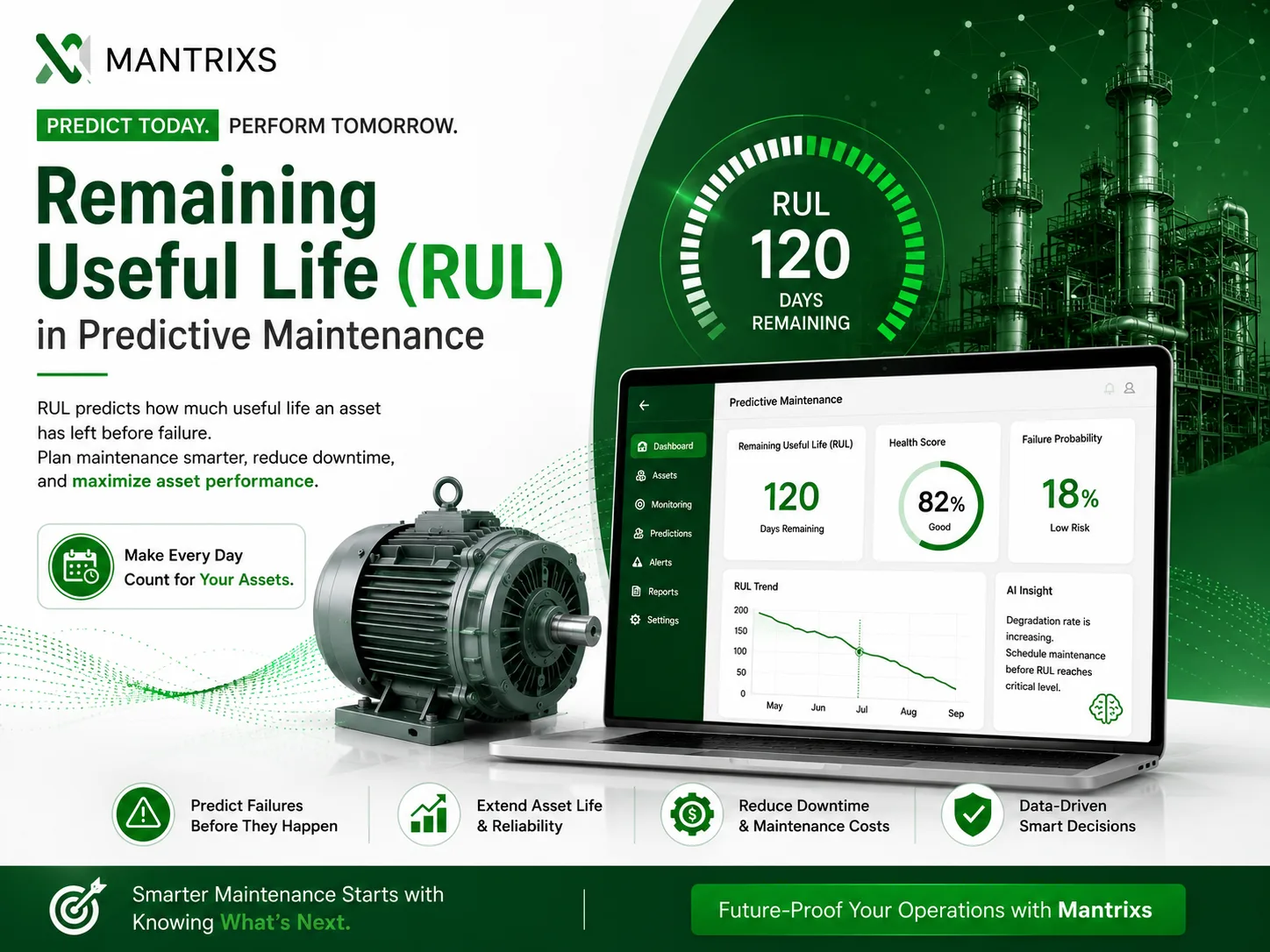
RUL stands for "Remaining Useful Life." It is the estimated number of rounds that a piece of equipment will last before it breaks. In predictive maintenance, RUL predictions help maintenance teams act at the right moment replacing or servicing assets before they break down, while avoiding unnecessary early interventions.
Every unplanned equipment failure carries a cost. It doesn't take long for downtime, emergency repairs, lost work, and safety risks to add up. Still, a lot of maintenance teams still use set schedules or fixes that are made after the fact, which don't take into account how an asset is really doing.
Remaining Useful Life changes that equation. Maintenance professionals can make better decisions about when to fix an asset by estimating how much working life it has left. This cuts down on failures, saves money, and makes critical equipment last longer. It explains what RUL is, how it can be predicted, and how it fits into today's predictive maintenance plan.
What Is Remaining Useful Life (RUL)?
The expected number of cycles, hours of operation, or time that a part or asset can keep working before it fails is called its "remaining useful life." Without going into too much detail, RUL is the distance between how an asset is now and when it can't reliably do its job anymore.
RUL isn't a set number. It's always changing because of how the equipment is used, how it breaks down over time, and the situations in which it works. When repair teams have a good idea of the RUL, they can stop guessing and make decisions based on facts.
Why Is RUL Important in Predictive Maintenance?
Predictive repair depends on keeping an eye on the state of equipment to see when it might break down. RUL is the most important part of this method; it turns raw sensor data and degradation signs into a timeline that can be used.
Teams might know that a machine is breaking down without RUL forecasts, but they might not know how important it is right now. With RUL, they can put work orders in order of importance, plan downtime strategically, and divide up resources based on real risk instead of guesswork. This is especially helpful in fields like manufacturing, aviation, energy, and transportation where broken equipment can have big effects further down the line.
How Does Remaining Useful Life (RUL) Prediction Work?
RUL prediction combines data collection, modeling, and analysis to estimate the remaining life of an asset. These steps are usually what happen:
Collecting data: Sensors keep an eye on important factors like sound, temperature, pressure, and current draw.
Feature extraction: Patterns and outliers that are useful are found in the raw data.
Modeling degradation: To understand how an object breaks down over time, a model is made.
Estimation of RUL: The model guesses when the asset will fail, giving an estimate of how much time it has left.
This process can go on all the time and be automated. As new data comes in, RUL estimates can be changed in real time.
Key Factors That Affect Remaining Useful Life
Several factors affect how quickly an asset breaks down, which in turn affects its RUL:
Operating conditions: Extreme temperatures, changes in load, and external factors all speed up wear.
Usage intensity Equipment that is used close to or beyond its maximum capacity breaks down more quickly.
History of maintenance Assemblies that are well taken care of tend to have longer, more regular useful lives.
Material quality and design The natural durability is affected by the grade of the parts and the engineering tolerances.
Age and past failures Assets that are older or have been fixed more often may break down faster than what baseline models predict.
When maintenance workers know about these things, they can better understand RUL estimates and make changes to their predictions when operating conditions change.
How RUL Helps Prevent Equipment Failures
RUL gives teams a picture of how healthy assets will be in the future. Instead of fixing problems after they happen, maintenance workers can take action in the window of time between early wear and failure, which is when it's best to do something.
For instance, if the RUL estimate for a rotating machine drops to 200 hours of use, the repair team can replace it during the next planned shutdown rather than risk a breakdown in the middle of production. This kind of targeted intervention reduces both emergency repairs and unnecessary replacements.
RUL vs. Preventive Maintenance: What's the Difference?
Preventive maintenance plans service intervals based on time or usage thresholds, like replacing a part every 6 months or 10,000 cycles, no matter how good or bad it is. This method is simple, but it wastes a lot of time and money. Assets are sometimes replaced when they still have plenty of life left, and other times fail before the planned service date.
On the other hand, RUL-based maintenance looks at real-world data to figure out when action is really needed. A component showing no signs of degradation at its scheduled replacement date can safely stay in service. When one breaks down faster than expected, it sets off an earlier reaction.
Preventive maintenance is the best choice when it's not possible to keep an eye on the equipment or when the cost of failure is low. Choose RUL-based predictive maintenance when assets are critical, failure consequences are high, and sensor data is available.
Benefits of Using RUL in Predictive Maintenance
There are measurable benefits to adding RUL estimation to a maintenance program:
Less unexpected downtime Teams fix problems before they happen, not after they happen.
Lower maintenance costs resources are used based on what is needed, not on set schedules.
Longer useful life of an asset Early repairs stop failures that cause more damage.
Improved safety Failing equipment in high-stakes environments is found and addressed sooner.
Better planning of resources Maintenance teams can more accurately predict how many extra parts they will need and how many workers they will need.
Common Methods for Predicting Remaining Useful Life
There are different ways to determine RUL, and each one works best in certain situations and with different amounts of data:
Physics-based models: These use engineering ideas to show how things break down, like how fatigue cracks grow. Highly accurate for well-understood failure modes, but require deep domain knowledge.
Data-driven models: Machine learning methods, such as recurrent neural networks (RNNs) and long short-term memory (LSTM) networks, use past sensor data to learn how things break down. Useful when you have access to large datasets.
Hybrid models Combine methods based on physics and data to make models more accurate while still being able to be understood physically.
Statistical methods Methods like Weibull analysis and proportional hazards modeling use records of past failures to estimate the chance of something failing.
The right method depends on data availability, asset criticality, and the specific failure modes being modeled.
Challenges of Remaining Useful Life Prediction
Even though RUL prediction is useful, it's not easy:
Data quality Inaccurate, incomplete, or inconsistent sensor data leads to unreliable estimates.
Model generalizability means that a model that was trained on one machine might not work well on another that has different operating conditions.
Failure mode complexity Assets can fail in multiple ways, and models must account for each failure mechanism.
Uncertainty quantification RUL estimates are predictions, not guarantees. Teams need to know the range of possibilities for each estimate.
Costs of implementation: Putting sensors in place and making predictive models involves spending money up front on hardware, software, and expertise.
To solve these problems, you usually need a good data system, experts from different departments, and constant model validation.
How CMMS Software Supports RUL-Based Maintenance
A Computerized Maintenance Management System (CMMS) is a key part of putting RUL forecasts into action. A CMMS is where insights are put into motion, even though predictive models may be made in separate analytics platforms.
Some important CMMS features that help with RUL-based maintenance are:
Work order automation Triggering maintenance jobs automatically when an asset's RUL drops below a defined threshold.
Tracking the history of an asset means keeping thorough records of failures, repairs, and readings of conditions that are used by RUL models.
Inventory management Ensuring spare parts are available when RUL predictions show an upcoming replacement need.
Reporting and analytics: Showing long-term trends in the health of assets and how well they are maintained.
When a CMMS is integrated with condition monitoring tools and sensor data streams, RUL estimates can flow directly into maintenance workflows—closing the loop between prediction and action.
How to Improve Maintenance Decisions With RUL
To get the most out of RUL-based maintenance, you need to do more than just set up sensors and run models. Here are some practical steps you can take to improve your approach:
Start with critical assets Focus initial RUL efforts on equipment where failure has the greatest impact.
Spend money on good data, regularly calibrate sensors and check data before putting it into models.
Train the repair teams. Technicians can only use RUL estimates if they know how to read them and act on them.
Validate and improve models Check RUL predictions against real failures and make changes to the models as needed.
Connect to your CMMS Make sure that predictions are directly translated into planned work orders and purchases.
The Future of Maintenance Starts with RUL
Estimating how much useful life something still has is one of the most useful uses of predictive maintenance. It turns sensor data into a real number that tells you when and how to act. When it comes to maintenance workers who are in charge of important assets, RUL changes the question from "when did it fail?" to "when should we act?"
The shift to RUL-based maintenance isn't instantaneous. It needs the right data infrastructure, the right modeling approach, and support from the whole organization. But in situations where downtime is expensive and safety is very important, it is clear that the investment is worth it.
First, figure out which of your assets are the most at risk. Then, look at how well you can collect data now, and see how your CMMS can help condition-based processes. From there, it's much easier to see how to get to smarter, more efficient care.
Keep reading
More from the Mantrix blog

Parking Lot Maintenance: Save Money with Preventive Care
A proactive parking lot maintenance strategy helps prevent potholes, cracks, drainage issues, and costly repairs. This guide explains preventive maintenance, common parking lot problems,
Agtech Farm Equipment Maintenance: Common Challenges and How to Solve Them
Farm equipment maintenance is becoming more complex as modern machinery evolves. Learn how digital maintenance systems, preventive scheduling, and agtech solutions can reduce downtime and improve equipment reliability.

Elevator Maintenance Software in Pakistan: Handling Assets, Work Orders, and Inspections
Discover how elevator maintenance software in Pakistan helps facility teams manage assets, inspections, work orders, maintenance records, and multiple properties.