Best Retail Store Maintenance Software in Pakistan
Retail chains in Pakistan need a reliable way to manage maintenance across multiple stores. Discover how retail store maintenance software helps track work orders, manage vendors, schedule preventive maintenance, and reduce downtime with Mantrixs.
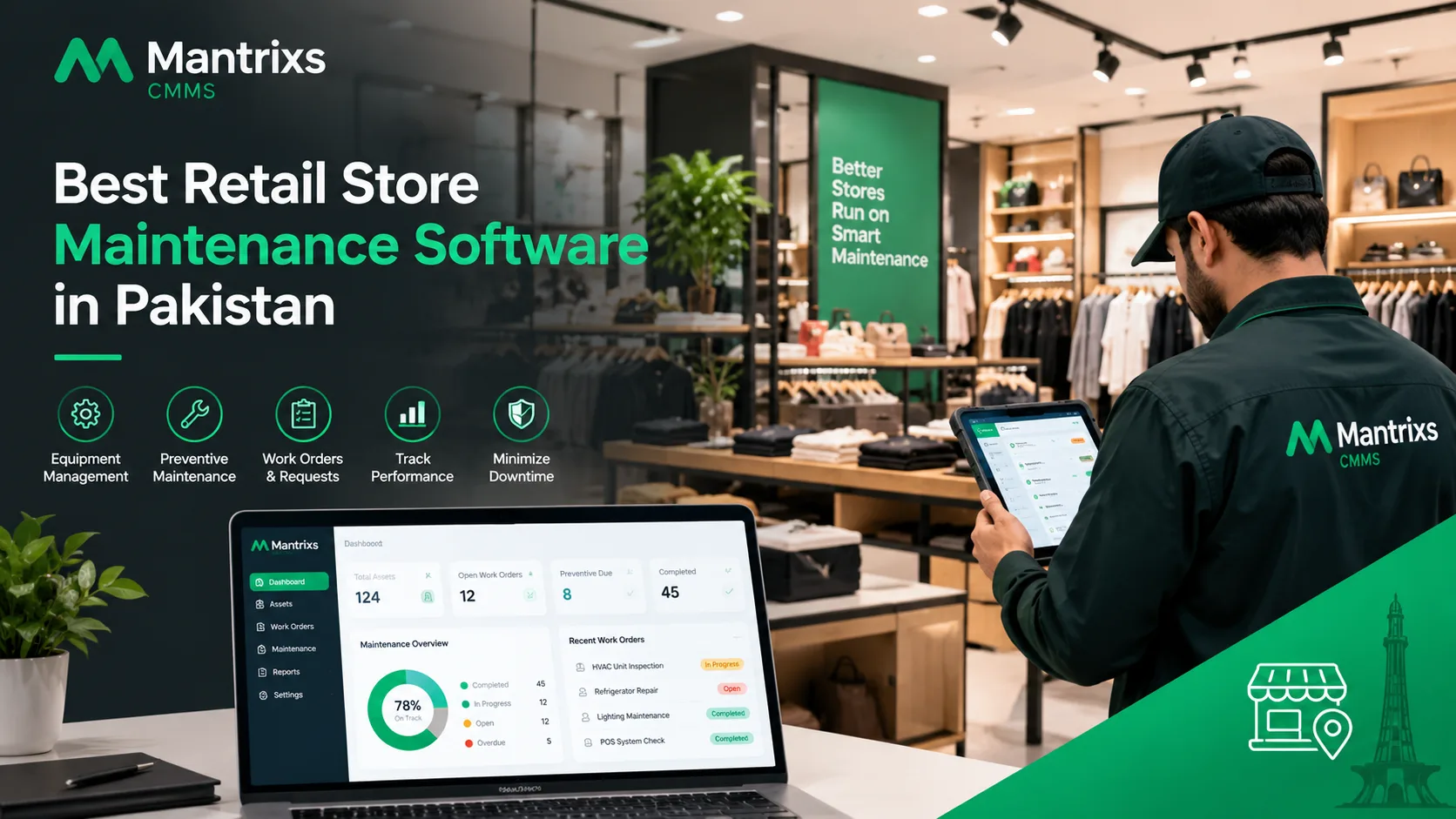
If you go into any busy store in Lahore, Karachi, or Islamabad, you'll notice how much equipment is working in the background. There is air conditioning, refrigeration, lighting, security systems, escalators in bigger stores, and hardware for the cash registers. When this equipment breaks, like an AC that stops working in the middle of the summer when a lot of people are shopping, customers only notice it.
For retail chains with multiple stores across Pakistan, it quickly becomes too much to handle all of this through phone calls, WhatsApp texts, or casual reports from store managers. This is where dedicated maintenance software changes the way that teams that run stores actually work.
Why Retail Maintenance Is Different From Other Industries
Some things about retail maintenance make it harder to handle than maintenance in a single plant or building:
One management team for many places. A store company with fifteen locations in three cities usually still has a small central facilities team that takes care of all of them.
time away from customers. A broken AC or fridge in a store is seen by every customer, while in a factory it only affects internal output. This has a direct effect on sales and how people feel about the brand.
Structures with multiple owners and franchises. In Pakistan, a lot of retail brands are run like franchises. This means that repair requests come from different owners or managers, and they need an easy, standard way to report problems.
A lot of foot traffic wear. In high-traffic retail areas, things like doors, floors, escalators, and HVAC systems wear out faster than in most offices, so they need to be checked for problems more often.
The Real Cost of Reactive Store Maintenance
If a shop doesn't have a structured system for maintenance, things break, the manager calls someone, and the problem is fixed, but no one keeps track of what happened or how long it took. In the long run, this has real costs:
Lost sales because of broken equipment, especially when cooling systems fail and stock goes bad.
Different shops calling different technicians for the same type of repair because of bad vendor management
No way for regional or corporate managers to see which stores have problems that keep happening.
It costs more to fix things because emergency calls are usually more expensive than regular maintenance.
Customers think that a store that isn't well taken care of means the service they receive as a whole is bad, which hurts the
What to Look for in Retail Maintenance Software
Retail businesses need software that can be used in a lot of different small locations, not just one big one. Some important things to consider are:
1. Dashboard for multiple stores One view that shows the state of maintenance at all locations, so managers in other regions or the main office don't have to call each store to find out what's going on.
2. Easy Request Submission for Store Staff: Store managers and staff, who aren't usually tech-savvy, should be able to quickly report a problem from their phones, without having to figure out a complicated system.
3. Assignment of Vendors and Technicians It's possible to give certain problems to approved vendors or in-house experts, and it's easy to see who did what and when.
4. Maintenance to keep store equipment in good shape When HVAC, refrigeration, and electrical systems are serviced regularly, they don't break down in the middle of the day, which can be very expensive.
5. Keeping track of recurring issues reporting shows which shops or types of equipment have problems over and over again, which helps management decide when fixing something is no longer cheaper than buying a new one.
6. Keeping track of vendor costs and spare parts Being able to see which network repairs and parts cost the most means that budgets are based on real usage instead of guesswork.
How this works in a chain of Stores
Think about a store chain that has twenty locations in Pakistan. If there isn't an official system in place, it could take hours to get the right person to know about a refrigeration problem at one branch. This is because the store manager has to figure out who to call, and the head office doesn't find out until the food has gone bad.
With Pakistani retail store maintenance software, the manager can quickly record the problem on his or her phone. The system sends it immediately to the closest approved vendor, keeps track of how long it takes to respond, and sends real-time updates to the head office. Over the course of a few months, the same dashboard shows that three stores have repeated problems with their refrigeration. This is information that would have taken months of calling different stores and putting it together by hand, but it is now instantly visible.
How Mantrixs CMMS Supports Retail Operations Teams
Instead of having stores, vendors, and head office talk to each other in different ways, Mantrixs gives retail operations teams a single system to handle maintenance across all locations. Among these are:
A central dashboard that shows all of the shops' maintenance work
mobile-friendly request entry for store staff who aren't tech-savvy
Planned preventative repair for electrical, HVAC, and refrigeration systems
Assigning vendors and keeping track of their work by response time
Reporting that shows problems that keep happening by shop or type of equipment
This changes maintenance from a reactive, store-by-store scramble to a managed, obvious process across the whole network. This is great for retail chains that are growing.
Final Thoughts
Maintenance in stores doesn't get the care it needs until there's a problem that affects customers. Moving away from phone calls and unstructured reports and toward a structured maintenance system isn't just about saving time for retail chains in Pakistan; it also protects sales, brand reputation, and vendor costs in every location.
If your retail chain still handles store maintenance with a bunch of different calls and messages, you should check out what a connected system looks like. You can get a free demo from Mantrixs today to see how centralized maintenance management can cut down on downtime, keep repair costs low, and make sure all of your stores run the way your customers expect them to.
Keep reading
More from the Mantrix blog
Best HVAC Maintenance Software in Pakistan for Facility Teams
Discover how HVAC maintenance software helps facility teams in Pakistan schedule preventive maintenance, track repairs, and reduce costly downtime.
How Power Plants in Pakistan Are Using Maintenance Software to Prevent Outages
Explore how maintenance software helps Pakistan’s power plants reduce outages, improve equipment reliability, and shift from reactive to proactive maintenance.

Best Inventory Management Software for Maintenance Teams in Pakistan
Discover the best inventory management software for maintenance teams in Pakistan. Track spare parts, stock levels, usage, and reduce equipment downtime.